NIR · Microwave · Capacitive · TDR.
What fits your material?
We'll show you honestly where microwave wins — and where it doesn't. 12 criteria, four methods, one clear recommendation.
Which criterion
matters to you?
Multiple selection. More checkmarks = sharper recommendation.
Where each method shines.
Microwave (2-PMR)
Strengths: volume measurement, density-independent, robust to dust/temperature, long-term stable.
Recommended for
- + Wood-based panels (MDF, OSB)
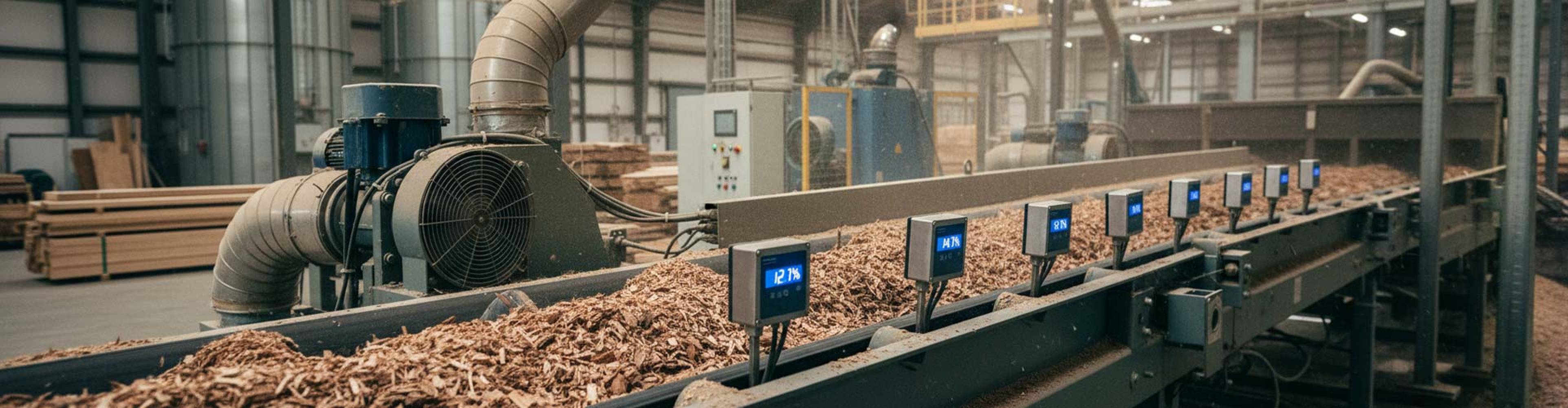
- + Pellets, wood chips
- + Polymer pellets
- + Fertilizer, alumina
NIR
Strengths: multi-component analysis (fat, protein, ash), very dry materials.
Weaknesses
- − Surface measurement only
- − Cleaning-intensive
- − Lamp aging
- − Color-sensitive
Capacitive
Strengths: very cheap to buy, simple mechanics.
Weaknesses
- − Strong temperature dependency
- − Density-sensitive
- − Contact method
- − Frequent re-calibration
TDR
Strengths: robust in homogeneous materials (soil/bulk), deep profile measurement.
Weaknesses
- − Probe contact required
- − Slow rate (1–10 Hz)
- − Sensitive to salinity
- − Maintenance-prone
FAQ Method Comparison.
Is microwave always superior? +
No. For very dry materials (< 1 % moisture) or pure chemical analysis (fat, protein), NIR has advantages. We deploy microwave where volume moisture, density independence, dust/temperature tolerance and long-term stability matter.
Why not combine both methods? +
It's done. Especially in food lines — NIR for fast chemistry analysis, microwave for robust moisture control. We deliver OPC-UA data feeds that coexist with NIR systems.
How do total costs differ? +
Microwave has higher capex (typical 35–180 k€) but barely any opex — no lamps, no optics cleaning. NIR TCO grows from lamp replacement and optics maintenance. Over 10 years, usually cheaper.
What's the difference vs. Berthold / Tews / Hydronix? +
All use microwave. The difference is the 2-PMR method — simultaneous moisture and density from one resonance curve. Others need separate density capture or compensate mathematically.
Which methods do you use yourselves? +
At Rellingen we measure customer samples gravimetrically (reference), microwave inline (production), and Karl-Fischer (chemical water, lab reference). NIR only when the customer already has it on-site.